Raleigh Haz-Mat History

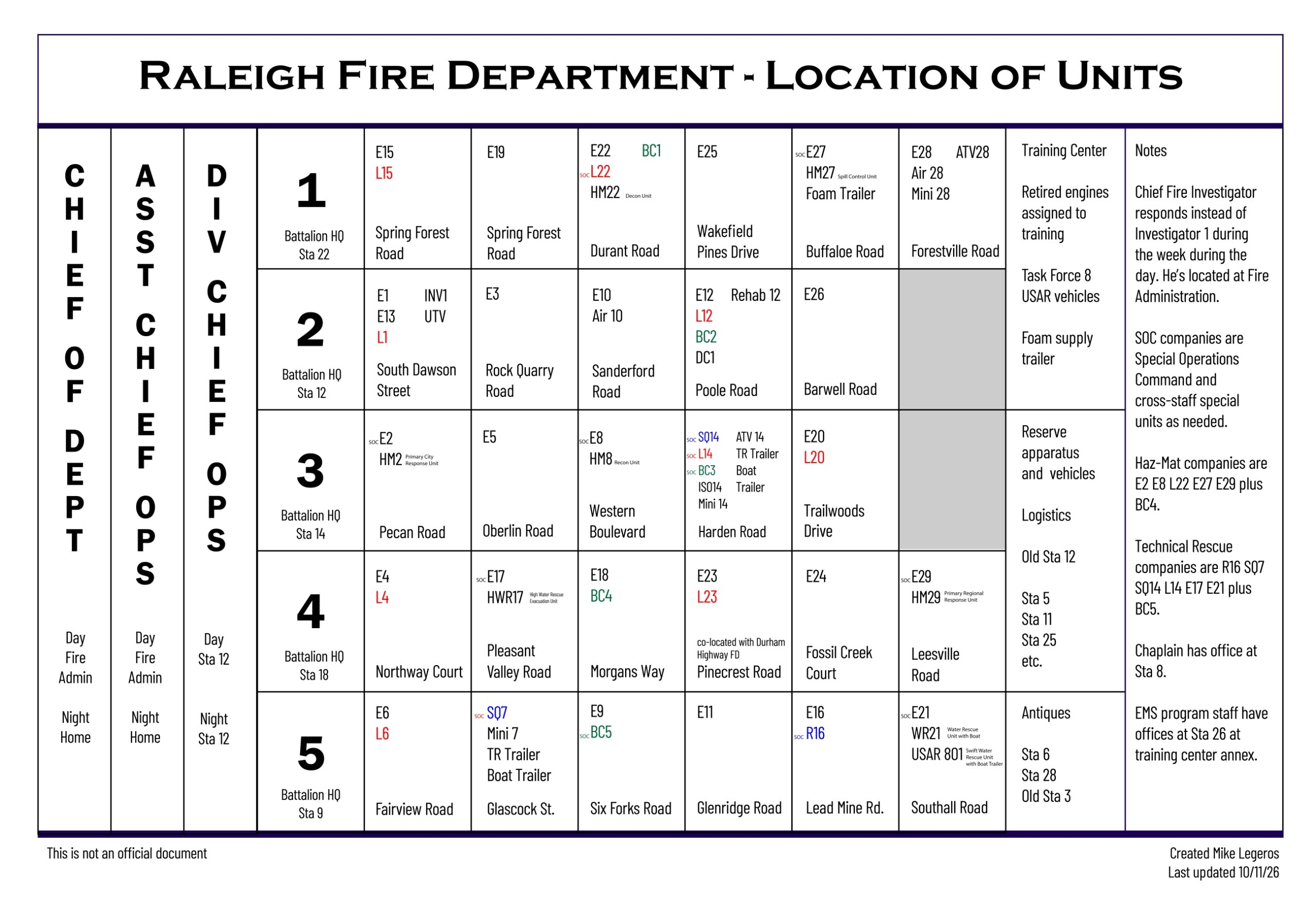
Research notes on the history of the Raleigh Fire Department hazardous materials response program. 

Pre-History

1980, Nov 19 – New federal regulations took effect to ensure safe management of hazardous waste, including identifying/notifying authorities of all sites that contained such products.

1982, Sep 13 – Fire in Charlotte at a chemical company forced the evacuation of several neighborhoods. Subsequently, the Raleigh Fire Marshal began compiling a list of haz-mat storage areas in the city.

1982, Oct 7 – News reported that for about a month, the fire department had been compiling an inventory of haz-mats stored in Raleigh. City administration was planning to propose a comprehensive “hazardous waste policy” by the end of the year. And part of the reason was the coming completion of the “southern leg of the Beltline,” which would require rules to “keep hazardous wastes from being transported through Raleigh.” [N&O, 10/7/82]

1983 to 1988

1983, March – City manager submitted a report to council on sites in the city that stored “hazardous waste.” [N&O, 7/10/83]

1983, May – City administration revised their inventory of sites that stored “hazardous waste.” It identified 19 sites in the “city’s fire service area” that were “primary hazardous materials rises.” Plus another 38 sites that could be “hazardous under adverse conditions.” [N&O, 7/10/83]

1983, Jun 10 – News reported that a city council at a work session for the FY84 budget endorsed a budget request to train and equip a “special unit of firefighters” to respond to haz-mat emergencies. [N&O, 7/10/83]

The team was part of a city administration plan to “tighten the city’s regulation of hazardous materials.” Also in the city’s plan were changes considered to the city code that would regulate disposal of haz-mats at landfills within the city, and another that would establish a permitting processes for storing haz-mats including the periodic monitor of storage sites. [N&O, 7/10/83]

Fire Chief Thomas Kuster, who took office on February 1, 1983, and was the first “outside chief” hired in the department, had proposed the team “after evaluating the department [and concluding] that the special hazardous materials unit was needed.” [N&O, 7/10/83]

Continue reading ‘Raleigh Haz-Mat History’ »

Facebook Comments

Wrightsville Beach Line of Duty Death – December 6, 1981

This is a version of a Facebook posting from December 6, 2021.

On December 6, 1981, Wrightsville Beach volunteer Lt. Robert M. Wynn, 28, died in the line of duty at the Doak Apartments fire. Also severely injured was volunteer firefighter Jon Dennison, 21, who suffered second and third degree burns.

At 1:13 a.m. on a Sunday morning, the fire department was dispatched to 555 S. Lumina Avenue. Arriving firefighters found the Doak Apartments heavily involved with fire. And flames were impinging the Hanover Seaside Club building, and also threatening Carolina Temple Apartments,  immediately north of the Doak. [1]

[1]Wind blowing to the southwest prevented the flame from spreading to the Carolina Temple building, but they also caused the Seaside Club building to catch fire.

Recounts Fire Chief Everett Ward in this short documentary film, within eight minutes he received a report from his captain, Bill Ivins, that he had lost two people in the club building. Recounted the department’s web page, Ivins along with Dennison and Wynn had entered the club building with hose line(s). Ivins left that position momentarily to help set up a deluge gun. When he returned, he found the hose line slack.

Dennison and Wynn had reached an upper floor balcony of the club building–accounts differ, if it was the second or third floor–and were going room-to-room, window-to-window, moving along the balcony and spraying water into each room. They were advancing down the balcony when “everything went black” and fire was all over them.[2]

[2] There are conflicting accounts of what happened. The department’s web site said a severe flashover occurred. A story in the News & Observer said a pressured tank of petroleum exploded, enveloping the building in flames and trapping the two.


Courtesy Wrightsville Beach Fire Department

Dennison escaped after dropping 18 feet from a window, landing on the air pack that he was wearing. Wynn had crawled underneath the smoke to a porch, where he was later found. Both of these details were noted in a 2016 retrospective in the Lumina News.[3]

[3] Watch the film for more a detailed account of what was happening on the fireground, as first Dennison was located, and then Wynn.[3]

By about 10 to 12 minutes after arrival, the Doak building was fully involved and the club building was becoming fully involved. Dennison was the first to be found, followed by Wynn.

Both Firefighters Found

Crews found Wynn on the rear balcony with flames above them. They used a ladder to rescue him. Wynn was unconscious and found in a fetal position. As the chief recalled, he never regained consciousness and was pronounced dead on arrival at New Hanover Memorial Hospital.[4]

[4] His certificate of death listed thermal burns and smoke inhalation as the cause of death.

Dennison was transported to Cape Fear Hospital with second- and third-degree burns over 25 percent of his body, reported the News & Observer. He spent 82 days in the hospital before eventually returning to duty and continue to serve in the then all-volunteer department.

Robert Wynn worked as an assistant manager at the Blockade Runner Hotel. He had responded from the hotel that morning just as he was getting ready to go off shift. He had moved to Wrightsville Beach from Beech Mountain, where he had worked in the Parks and Recreation Department. At the time of the fire, he was considering moving back to Greenville, SC, to resume a career in parks and recreation and take care of his ailing father, noted the department’s web site. 

The Aftermath

Among the safety measures implemented after the fire included a town bond measure to improve a new water systems for the beach[5], passage of a residential sprinkler ordinance, and purchasing personal alert system devices for the fire department. Radios were improved, more pagers were purchased, and the town board was more supportive of the department and its requests, recounted Chief Ward.

[5] As recounted in the film, the firefighters couldn’t get enough water from the hydrants at the time.

The fire was investigated by the town police department, the county sheriff’s office, the State Bureau of Investigation, and several insurance agencies. No definitive cause was ever determined.

The Doak apartment building–a colonial-style structure with three stories and 14 apartments–was erected in 1935, and originally named the Beaty Apartments. Both the Doak and Seaside Club buildings were completely destroyed within three hours.


Courtesy Wrightsville Beach Fire Department

Memorial Dedicated in 1983

In May 1983, a memorial was dedicated to Wynn at the area of what was then called the Municipal Dock. Today, it’s named Wynn Plaza.

Recounted the department’s web site, the Harbor Island Garden Club assisted in landscaping and was instrumental in the dedication that was conducted in May of 1983. A flagpole was donated by J. C. Drewry, from the old post office at Station 1. The Parks and Recreation Department arranged the memorial and Public Works placed the flagpole into position.

Today, the department maintains the flag at Wynn Plaza as a tribute to the man who gave his life in the service of his community on December 6, 1981.

In 2001 the park was remodeled and rededicated as a new symbol of co-operation and public spirit that Wynn represented. The project was completed through the efforts of other dedicated citizens, the members of the Wrightsville Beach Volunteer Firefighters Association, and an extensive partnership of community leaders.  

In 2016, on the 35th anniversary of the fire, a remembrance ceremony was held at Wynn Plaza, where the department debuted its newly formed honor guard.

Sources/References

Lumina News, December 7, 2016, Town remembers Wynn 35 years after deadly fire
https://luminanews.com/2016/12/town-remembers-wynn-35-years-deadly-fire/

News & Observer, December 7, 1983, Beach Blaze traps, kills firefighter, via NewsBank, via State Library of North Carolina access, https://statelibrary.ncdcr.gov/research/information-researchers/online-resources

Orange St Films, December 7, 2018, Doak Apartments Fire – 1981 – Wrightsville Beach Fire Department, https://www.youtube.com/watch?v=gk8HGkbvA5c

Wrightsville Beach Fire Department history, https://www.townofwrightsvillebeach.com/253/History-of-the-Fire-Department

Facebook Comments

Charlotte Fire Alarm System History

This posting is a consolidation and expansion of two Facebook postings and discussion threads from December 2025. See part 1 and part 2

Random notes on the history of fire alarm “street boxes” in Charlotte.

Reference Documents

View list of box locations before 1975 (PDF)

Timeline

Before 1900

1887, Nov – First fire alarm system began operating. Had 47 boxes, each locked, with keys distributed to four closest houses. Each alarm sounded bells in the engine houses, the water works, and bell tower. Each alarm was repeated four times in intervals of 20 seconds. The box numbers were two digits. Additional signals were one bell for test of a line, three bells after an alarm to signal that the fire was out, five bells after an alarm to request more water pressure, ten bells repeated three times for a general alarm. Thomas Edison designed the system and supervised its installation. [CFD, CO, 11/5/87]

1900 to 1929

1901, Oct 10 – Contract signed for new fire alarm system with Gamewell. [CN, 10/1/01]

1901, Dec 30 – New system tested. Had 34 boxes, if counting correctly. [CN, 12/30/01]

1905 – System had 35 boxes. [Sanborn] 1911 – System had 48 boxes with “automatic fire bell” at fire station. [Sanborn]

1929 – System had 144 boxes, fire alarm system at headquarters. [Sanborn]

1930 to 1949

1934, Aug 1 – City’s first Public Works Administration project was completed yesterday. Fire alarm system expanded with 124 new boxes at a cost of $31,000. [CN, 8/1/34]

1940, Aug – National Board of Fire Underwriters submits report with citywide recommendations, including alarm system improvements. They recommend additional boxes be installed so a box is available with 800 feet of “important groups of buildings in residential districts.” Also, boxes in high value districts add a colored light to help locate them at night. Also, that boxes be tested monthly and after electrical storms. Also, that “four telephone trunk lines to the public exchange be reserved for fire calls only.” [CO, 8/18/40]

1950 to 1969

1950, May 23 – New Gamewell, class “A” fire alarm system activated. Changeover from the old system was completed the next day. The $200,000 system had 647 boxes, with 300 more than the former system. It was the “most modern fire alarm apparatus in any Southern city. Said a news release, “the new system includes a completely new central station installation and signal equipment for eight engine houses. Within the next few months the last of 545 virtually foolproof fire alarm boxes will be in operation. These will include 321 of the latest type and 224 old ones completely modernized. All can transmit alarms under such adverse conditions as broken wires or short circuits.” Continued, “one of the unique features will be the first municipal installation of Gamewell voice recorders. These will permanently transcribe all voice signals that come into central station, including telephone, radio, and loud-speaker communications.” [CN, 5/25/50; CFD]

1958, Mar 12 – City ordnance passed authorizing $134,000 in bonds for enlarging and extending the fire alarm system. [CN, 3/17/58] The expansion was needed/related to the expansion of the city limits, which took effect on January 1, 1960. [CO, 6/22/58] An estimated 300 alarm boxes were needed for the new area. [CN, 2/18/58]

1967, Sep 24 – Shown in a newspaper article were 51 new “street boxes” sitting on the floor of Fire Station 16 on Park Road. The boxes had not yet been installed because the CFD lineman who would install them had been otherwise working on the Festival in the Park for the past two weeks. The new boxes were ready for installation in suburban areas, including Beverly Woods, Sharon Colony, and sections of Huntington Farms and Starmount. But said Fire Chief Walter Black, the festival didn’t have anything to do with the delay in installing the boxes. “Everything’s ready. All we have to do is put the boxes in.” [CO, 9/24/67]

1967 – Snapshot. Charlotte had about 1,000 alarm boxes and 500 miles of alarm system wire. It was maintained by seven lineman in CFD. [CO, 9/22/67]

1969, Apr 12 – Newspaper story. City has proposed shutting down the “auxiliary fire alarm system,” which 131 businesses used. When a sprinkler system was activated, an alarm was transmitted to the nearby street corner box. A proposed ordnance would prohibit new connections to the system, and require businesses to install their own systems, such as by companies like American District Telegraphic (ADT) company. The high cost of system maintenance was the cited reason. [CO, 4/12/69]

1970 to 1983

1971 – CFD received an estimated 2,000 false alarms that year. [CO, 6/6/72]

1972, April – CFD began removing boxes from areas with high false fire alarm rates. By 1978, they had removed 498 boxes from residential areas. [CN, 1/2/74, 5/16/78]

1972, Jun – Snapshot. charlotte had about 975 alarm boxes. [CO, 6/6/72]

1972, Jun 6- Newspaper story, “What is the solution to false fire alarms?” During the first four months that year, 772 fire alarms were reported from alarm boxes, and 634 were false alarms. Also, 90 of the 1,347 telephone fire alarms during the first four months were false. Each false alarm cost taxpayers a minimum of $200.

1972, Jun 19 – Newspaper story. CFD is considering removing alarm boxes from several areas after a “heavy weekend run of false alarms” along with the destruction of two alarm boxes. Total of 44 false alarms were received between 7 p.m. Friday and 3  a.m. that Monday, with 33 coming from alarm boxes. From the Plaza area came a “rash of 15 false alarms” on Monday morning. The “box smashings” were the first in 30 years, said the fire chief. Since January 1, 80 percent of all box alarms had been false. [CN, 6/19/72]

1972, June 30 – For last 12 months, CFD answered 6,216 calls, with 2,319 coming from alarm boxes. Of those, 2,319 or 82 percent were “unlawful.” [CN, 1/2/74]

1973, Sep – Fire Chief Jack Lee noted that boxes had not been installed in residential sections for nearly two years because there are so many phones. The boxes were originally placed in locations were phones were scared. And the boxes were being phased out except in downtown, where offices were closed at night, and in other business and industrial areas. [CO, 9/26/73]

1973 – Calendar year? Fiscal year? Out of 1,987 alarms from boxes, 1,633 or 82 percent were false. [CN, 5/16/78]

1974, Jan 2 – Newspaper story. False alarms in November 1973 dropped 40 percent since CFD started removing boxes from “areas plagued with false alarms.” Since April 1972, they had removed 73 boxes, said John R. Klein, “superintendent of fire alarms.” [CN, 1/2/74]

1975, Oct 29 – Newspaper article about upcoming city auction that will include fire alarm boxes. [CH, 10/29/75]

1977, Apr 6 – Fire Chief John Lee said in a presentation they were phasing out the 777 fire alarm boxes because they caused too many false alarms. The fire museum would get “first dibs” and the rest would be auctioned off for about $10 to $12. [CO, 4/6/77]

1977 – Calendar year? Fiscal year? Out of 1,109 alarms from boxes, 753 or 68 percent were false. Also, about 460 false alarms were reported by telephone. [CN, 5/16/78]

1978, Feb – That month, there were 36 false alarms from boxes. [CN, 5/16/78]

1978, May – News reported that CFD was phasing out boxes, which were expensive to maintain. And they were the source of 62 percent of false fire alarms in 1977. More than 800 (or more likely 200, one official citing a typo) had been removed during the past two years. [CN, 5/16/78]

1978 – City council donated several hundred old boxes to the Charlotte-Mecklenburg Fire Museum. [CN, 11/10/79]

1979 – As a fundraiser, the fire museum gave away the old alarm boxes in exchange for a contribution of at least $25. [CN, 11/10/79]

1983 – In May and September, newspaper advertisements were run for “fire alarm boxes for sale, poor condition, $25 each” from “Fire Department Supply, 1200 Otts Street.” [CN, 5/20/83 + others ]

Facebook Comments

Two Alarms at the Raleigh Convention Center

See Legeros photos | Listen to radio traffic

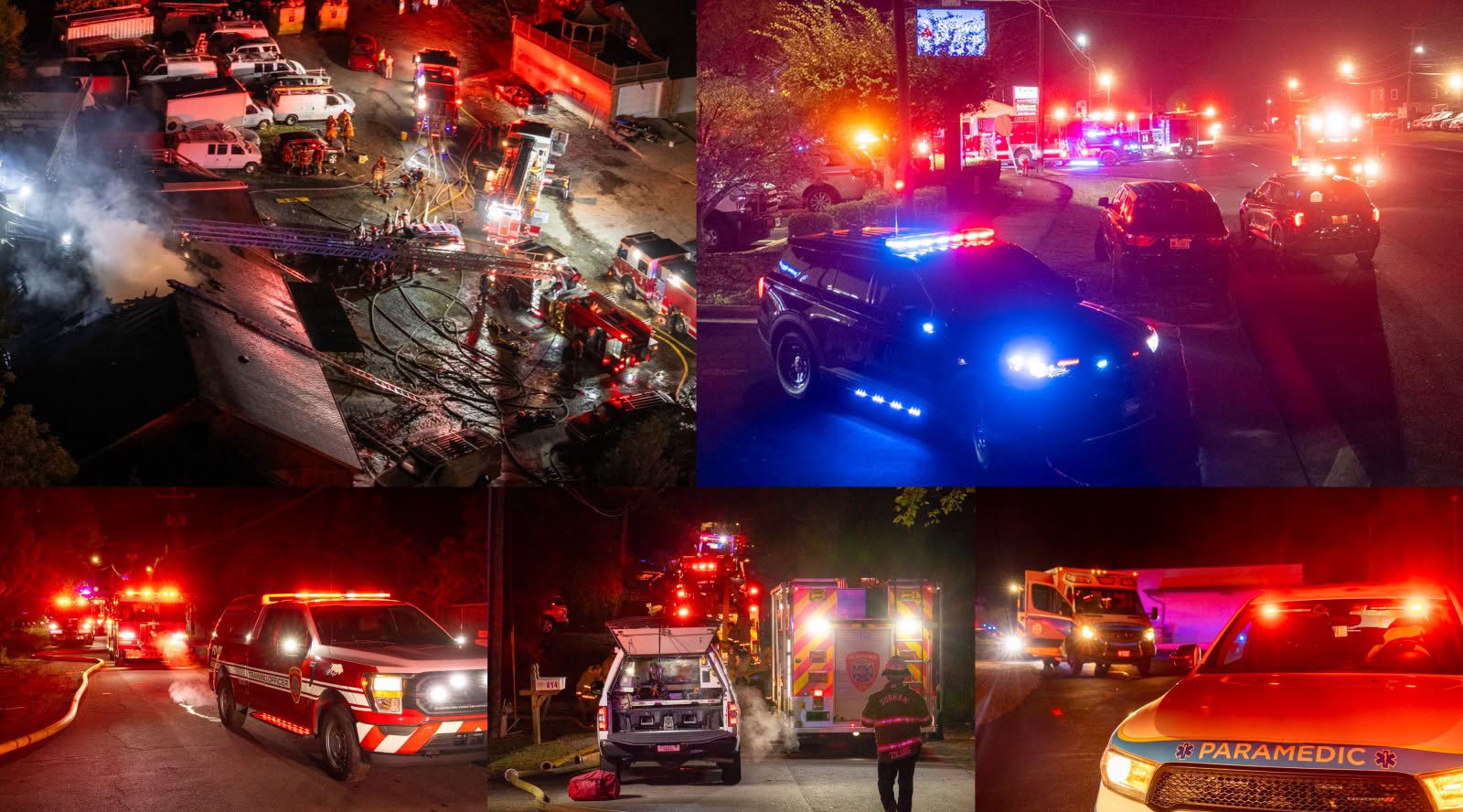
Two alarms were struck at the Raleigh Convention Center at 500 S. Salisbury Street on Monday night, December 1, 2025. Dispatched at ~9:29 p.m., the first-arriving units were from nearby Station 1 on South Dawson Street. Ladder 1 was first-arriving, reporting a working fire, and requesting a second alarm. Narrative notes are below. 

Run Card

  • First Alarm – E13 E1 E3 E2 L1 L6 R16 B2 B3 ISO14
  • Added – E5
  • Working Fire – A10 DC1 INV1 B5
  • Second Alarm – E6 E8 L14 L15 Sq7 Rehab 12
  • Added A28, Chief Investigator, Asst. Chief Logistics, E16 (relief)
  • EMS – M25 M71 M73 M78 M909 EMS83 D3 D7
  • WC1

Narrative Notes  Continue reading ‘Two Alarms at the Raleigh Convention Center’ »

Facebook Comments

Two Alarms on Brooks Avenue – November 16, 2025

Two alarms were struck at a house fire in Raleigh on Sunday, November 16, 2025. 

Dispatched ~2:50 p.m. for 1345 Brooks Avenue. One- and two-story, single-family dwelling with 4,116 square-feet. Built 1948.

With gusty wind conditions that day, statewide.

Engine 6 first-arriving with smoke showing. Upgraded to working fire. Interior attack to start, with crews facing difficult conditions due to the wind. Also, the structure had an addition on the rear, which added challenges. 

With zero visibility conditions inside, multiple ventilation holes were cut in the roof. But deteriorating conditions required their evacuation, for exterior streams. Crews later re-entered the structure. 

Two additional engines were requested with E3 E16 dispatched ~3:10 p.m. Second alarm later struck at ~3:24 p.m. Staging at Duplin and Churchill.

Fire through the roof, plus later roof collapse. Two aerials were raised, Ladder 6 and Ladder 14 (on reserve).

Evacuation tones were sounded on radio at about 3:08 p.m., but incorrectly transmitted as a mayday. It was quickly corrected on the radio. There was no mayday.

Engine 3 supplied Ladder 1. Engine 6 supplied Ladder 14 (on reserve).

Controlled around 3:58 p.m.

Run card included: E3 E4 E5 E6 E8 E9 E16 E17 L1 L6 L14 L20 Sq7 Sq14 R16 B3 B4 B5 ISO14 A10 DC1 INV1 Rehab 12 M10 M24 M74 D4


Raleigh Professional Fire Fighters Association photo


Raleigh Professional Fire Fighters Association photo


Mike Legeros photo

Facebook Comments

Relocating Fire Station 3 – November Update

This is an ongoing blog posting about the project to relocate Raleigh Fire Station 3.

Contents 

  • Nov 2025 – November Update
  • Feb 2025 – Construction Update
  • Nov 2024 – Design + Public Art Unveiled
  • Nov 2024 – Community Meeting Scheduled
  • Oct 2024 – Site Clearing Started
  • Aug 2024 – Construction Bid Awarded
  • May 2024 – Construction Bids Solicited
  • Mar 2022 – Call for Artists
  • Mar 2022 – Official Project Site
  • May 2021 – Design Contract Awarded
  • Nov 2017 – Property Purchased
  • Earlier Project History
  • Legacy Station 3

November 2025 – November Update

New Fire Station 3 on Rock Quarry Road is nearing completion. Occupancy is expected in December. Engine 3 will relocate from their current quarters at 13 S. East Street, from their 1951 engine house. 

February 2025 – Construction Update Continue reading ‘Relocating Fire Station 3 – November Update’ »

Facebook Comments

Run Card for Louisville Cargo Jet Crash

This is a blog version of a Facebook posting from November 5, 2025. 


Pleasure Park Ridge Fire District photos

Here’s a run card created by reader Kameron Brown–plus annotations added by Legeros–for the major incident in Louisville, KY, on November 3, 2025, involving an cargo jet crash + commercial building(s) + petroleum recycling facility just past the runway at Louisville International Airport.

UPS Flight 2976 crashed about 5:15 p.m. as it was departing the airport. The McDonnell Douglas MD-11FF crashed into multiple commercial buildings in an industrial area just south of the airport property, in the [initially reported] area of Fern Valley and Grade Lane.

Okolona Fire Department was first-due. Numerous fire departments were dispatched, including a multi-alarm response from Louisville. Extensive mutual aid was sent from neighboring counties. Some resources–notable ARFF units and foam quantities–travelled over 60 road miles to the scene. Over 200 responders were on scene.

As of Wednesday night, the there were nine fatalities including the three crew members, plus 16 people unaccounted for, and 11 people injured. As of Thursday night, November 6, the death toll had risen to 13 victims. 

Google for latest news reports, including updated fatality and injury counts and damage reports. Or listen to radio traffic from the incident: Part 1 | Part 2 | Part 3

See also Facebook discussion of this run card. See also initial Facebook incident discussion.

Note the number of departments with foam resources. That’s due to the many distilleries in the state. 

Counts by Type

ARFF crash trucks – 7
Bat Chiefs – 10
Other Chiefs – 18
Engines – 36
Foam Trailers – 4
Foam Resources, Other – 3
Fuel Trucks – 1
Haz-Mat Units – 9
Ladder Trucks – 14 (Quint designation + 3 Trucks/Towers)
Rehab – 1
Rescues – 8 (not including six airport ARFF units, also Rescue designation)
Tankers – 2 (or more?)
Utility Units – 4

Airport Fire Departments Continue reading ‘Run Card for Louisville Cargo Jet Crash’ »

Facebook Comments

MEDIC Starts Service in Charlotte – November 1, 1978

This is a blog version of a Facebook posting from November 6, 2025. 

Morning reading. How ’bout some EMS history from Mecklenburg County and Charlotte. Forty-seven years ago this week, MEDIC, the Mecklenburg EMS Agency, began operating as the county’s new ambulance service. They were placed in service at 12:01 a.m. on Tuesday, November 1, 1978.

They assumed the role from Mecklenburg Emergency Medical Service (MEMS), a private company that had provided service since 1960. Originally called Charlotte Ambulance Service, Inc., they were renamed MEMS in 1974.

Here’s a deep dive on the transition. Older readers who recall or lived these events, reach out with clarifications or corrections. Thank you.

Replacement Ambulance Service

MEDIC was intended as a replacement for MEMS. The county created their own ambulance agency after concerns about MEMS and their level of service.[1][2] But MEMS owner Robby Brandes tried to stop the county from operating their own ambulances. He filed a lawsuit in superior court that was rejected by a judge in August 1978.

After MEDIC started operating in November 1, 1978, MEMS also remained in operation and even though their contract with the county had expired at midnight on October 31, 1978. More on that in a moment.

[1] The county first tried to buy MEMS, but were never able to reach an agreement. The owner originally wanted $450,000, and the county offered $289,000. [CN, 11/2/78, 11/3/78]

[2] On May 1, 1978, the county commissioners authorized funding to establish the Mecklenburg Office of Emergency Services. They granted the office the authority to administer and operate the new EMS system. The county was oversaw the Central Medical Emergency Dispatch (CEMD) system.

Snapshot Of The New Service Continue reading ‘MEDIC Starts Service in Charlotte – November 1, 1978’ »

Facebook Comments

New Hope Station 2, Wendell Station 2, and No Man’s Land

Wake County history hit. For our Sunday reading, let’s take a deep dive into the story of New Hope Station 2 (now their main station) and Wendell Station 2. Turning the clock back at the fall of 1987, when county commissioners considered proposals to add fire protection to the so-called “no man’s land” in eastern Wake County.

Some 6,300 people lived in the area that was surrounded by four volunteer fire departments: New Hope, Knightdale, Rolesville, and Wendell. But each was more than five miles away, which meant longer response times and higher insurance rates.

Reported the News & Observer during that period, each department answered calls in the area under a “cooperative agreement,” but their trucks had to travel “seven or eight miles over congested roads” to reach the area.

Two of the departments, New Hope and Wendell, each wanted to establish “substations” in the heart of the area, which could “support only one department.” And the “winner would receive the right to tax property valued at $100.”

But the issue had proved difficult to resolve, because both New Hope and Wendell had been serving the area for 30 years and without receiving any tax revenue.

One homeowner was cited as paying about $400 per year for insurance in the “rural, unrated fire district.” That meant they had the highest insurance premium bracket.

But if the area became an “official fire district,” insurance on a $100,000 home could drop as much as $175, noted the story.

Source: News & Observer, September 7, 1987.

Before We Continue

Continue reading ‘New Hope Station 2, Wendell Station 2, and No Man’s Land’ »

Facebook Comments