|
1940
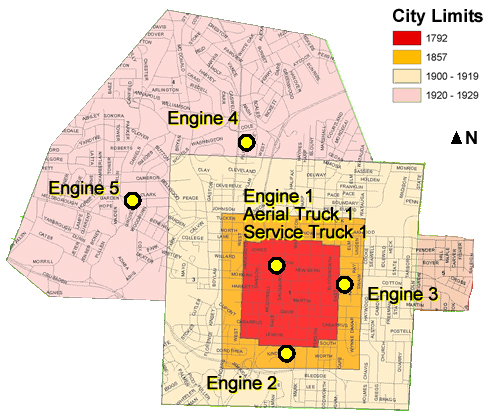
Five stations protecting 7.3 square miles and 46,879 residents.
Business section of Knightdale burned. Raleigh sent engine company. See Knightdale Fire Department history.
[MA] (February 7, 1940)
Private plane crashed on Highway 15-A, 300 yards south
of Raleigh Municipal Airport. Both occupants killed aboard the Fairchild
24. The next day, the plane burst into flames while being towed from site.
Unknown if fire department responds. [AA] (February 12, 1940)no12feb40, 13feb40
Land acquired by city, future site of permanent Station
6. Was it purchased for that
purpose? To be determined. Purchase price was $2,252.61. (August 12, 1940)
Delegation of 12 firefighters representing Firemen's Union appeared before City Commissioners to request "uniform pay raise of $20 a month for each of the 56 men from chief to private." Raleigh firefighters
were the lowest paid in seven comparable cities they note. From "captains through privates, Rocky Mount pay
was higher, as the following cities were in all ranks: Winston-Salem, Charlotte, Greensboro, Durham, Asheville, High Point." (August 27, 1940)no28aug40
Capt. K. J. Smith elected first president of North
Carolina Fire Fighters Association at the first state convention in High
Point. The group was affiliated with the American Federal of Labor. (October 29,
1940)no30oct40, 31oct40
First national lottery drawing conducted for Selective
Service Draft. (October 29, 1940)no29oct40
Drug store and apartment building at corner of Glenwood Avenue and Hillsboro Street burned.
The 9:38 p.m. alarm was received by telephone. Four lines and 2,300 feet of
hose were used. Firefighters remained on the scene until about 11:00 p.m.
(December 12, 1940)rfd, no13dec40R. C. Powell,
Fire Station 1 declared unsafe for occupancy by
City Building Inspector Pallie Mangum. He cited "gaping cracks in the
walls" and noted that frame supports protecting the walls could be used only as
temporary supports. The station, designed for horse-drawn apparatus, had been
weakened by motor trucks. Rear walls had been struck by backing trucks and
further weakened the walls. The Morgan Street building must be either
permanently repaired or replaced. No time limit for used of the present
structure was announced. (December 18, 1940)no19dec40
Hill's city directory dated 1940 summarized department as:
- Headquarters - 110-112 W. Morgan - dial 6514
- Chief - Ellis D.. King
- First Assistant Chief - W. Ralph Butts
- Second Assistant Chief - Alvin B. Lloyd
- Engine Company No. 1, 110 W. Morgan - Kenneth J. Smith, Captain
- Aerial Truck Company No. 1 & Truck Company No. 1, 110 W. Morgan - Chas L Hayes, Captain
- Engine Company No. 2, E Worth corner Fayetteville - R. Lee Matthews, Captain
- Engine Company No. 3, 135 E. Hargett - W. Leonard Choplin, Captain
- Engine Company No. 4, 505 Jefferson - John G. Harrison,, Captain
- Engine Company No. 5, 1914 Park Dr. - Edward G. McGhee, Captain.
1941
Residence at 713 Kimborough Street burned. Firefighters watched helplessly as the new home burned to the ground. The house
was a half-mile past the city limits and thus lacked a water supply. The fire truck's chemical tank
was used, but a stiff wind fanned the flames out of control. Fire was reported at 2:45 p.m. by telephone, a half-hour after the residents
left home. Within an hour, the building was entirely aflame. (January 11, 1941)no12jan41
Committee of firefighters addressed letter to City Commissioners
stating that "after February 15, the men will stop at the city limits unless
they were provided personal accident insurance, liability insurance, and relived
of responsibility for fire department equipment." The question of "fire coverage
beyond city limits" had been "in the air for several years." Last week, a
"suburban house no Stanhope Avenue" was lost because of "the reluctance of
firemen to proceed without authority." (February 6, 1941)no07feb41
Coal company in 500 block of W. Hargett Street burned. The 3:55 a.m. alarm
was received by telephone. Three lines and 1,500 feet of hose were used. (February 24, 1941)rfd
Police-Firemen's Civil Service Commission adopted a rule
requiring oral or written examinations for personnel offered promotions.
(April 4, 1941)no05apr41
Norfolk-Southern Railway coal chute at Glenwood Yards
on Sunrise Avenue burned. The 10:20 a.m. alarm was received by telephone. Three lines and 2,400 feet of hose
were used. The pumpers operated for eight hours. The stubborn fire brought thoughts of dynamite as a means of extinguishing the 200 tons of blazing locomotive fuel.
All but 40 tons were saved. Trains were temporarily rerouted while Raleigh firefighters
used all available equipment from Station 1. Workmen noticed the first signs of smoke from the overhanging coal chute about 10:00 a.m. The fire
was eventually controlled without the used of explosives. The railroad yards
were located in the northern part of Raleigh, near Roanoke Park.
[UF] (May 9, 1941)rfd,
no10may41
City officials released information about fire equipment damage occurring several weeks ago, including the seeming sabotage of 400-500 feet of hose with acid and an open oil petcock on the department's newest pumper. The incidents
were reported to the FBI, SBI, and State Commissioner of Insurance. Neither the FBI nor SBI chose to investigate. The open petcock, according to Fire Chief E. D. King,
was discovered by a fireman who noticed oil streaming from beneath the truck, after it answered a grass fire. Subsequently, three petcocks were discovered open. One, the oil drain, was wide open, but hadn't leaked enough oil to damage the engine. At the time, the driver reported thinking that he had hit a stump under the engine. When two other valves were found opened, sabotage was suspected. International Association of Firefighters President Fred Baer later investigated and refuted the claims of sabotage. He
determined that the damage to some 400 feet of fire hose was accidental. He also cites natural or accidental causes for both the alleged tampering of an eye-wash solution and opened oil and water petcocks on the fire engine. (April 11, 1941)no12apr41
Residence at 1800 Sunset Drive burned. The 1:39 p.m. alarm
was received by telephone. Three lines and 1,350 feet of hose were used. (May 11, 1941)rfd
Warehouse outside city destroyed by fire. The
blaze at Raleigh Hide and Junk Company, located more than a mile outside the
city limits, was discovered between 5:00 and 6:00 p.m. When firefighters arrive,
the roof and nearly all of the building had collapsed. Crews also extinguished a
fire that starts at a nearby three-room house. Engine 2 responded and three
lines were used. (May 29, 1941)rfd, no30may41
Station 1 site sold to state of North Carolina for $35,000.
On same day, the city purchased a $15,000 lot on S. Dawson Street from J. J. Towler for construction of a replacement fire station. (June 27, 1941)no28jun41
Southern Eastern Compress & Warehouse Company on Firwood Avenue burned. The 11:10 a.m. alarm
was received by telephone. Three lines and 1,500 feet of hose were used. (July 2, 1941)rfd
W. Ralph Butts appointed seventh Fire Chief,
serves 1941-1947. Butts joined the fire department in 1926. He succeeded
Chief Holland. He was appointed July 9, approved by Civil Service Commission
on July 11, and took oath on July 14. (July 14, 1941)cm, no10jul41, no12jul41, no15jul41
Gasoline leaked and ignited at the National Oil Company
on Lenoir Street (?). About 22,000 gallons escaped from four storage
tanks after heavy rain and flooding caused a stone wall to collapse and damage
the outlet pipes. The leaking gasoline ignited on Lenoir Street. Firefighters
prevent the flames from catching any structures ablaze. [UF] (July 13, 1941)no14jul41
Vacant house at 15 N. West Street burned. The 9:06 a.m. alarm
was received by telephone. Three lines and 1,050 feet of hose were used. (July 28, 1941)rfd
Alarm system equipment purchase announced. The $13,992 purchase included a new
switchboard, batteries, battery charging system, and an automatic timing and
tape system. Also announced was $2,700 of fire alarm cable. The new system,
purchased without bid from Gamewell, had a capacity of 300 boxes. The city
presently had 130 boxes and 35 miles of cable, wire, and poles. Some of the
replacement equipment was 30 years old or 16 years old. The new system was a
three-fold system, allowing alarms to be transmitted even if wires were broken. An
underground cable system was planned down Dawson Street from Morgan Street, to
the front of the property for the new Station 1. The city's old equipment
was transferred to the Gamewell company as part of the transaction. (July 29, 1941)no30jul41 Stephenson Music Store at 121 Fayetteville Street burned. The three-story brick store suffers $16,000 loss. The 4:08 a.m.
was received by telephone. Three lines and 1,600 feet of hose were used.
The fire was controlled in a few minutes. (August 10, 1941)rfd, no11aug41
Station 1 relocated to 412 S. Salisbury Street, former Station 2. Due to space considerations, both the aerial ladder and service truck
were moved to Station 2 at Memorial Auditorium. Engine 2 was relocated with Engine 1 at
S. Salisbury Street. Firefighters spent the entire day moving equipment, except when two trucks
were called to help extinguish blaze at the Professional Building annex. For two and a half hours, workers connected the fire department switchboard to the City Hall switchboard, where two firefighters
would assist the regular operation. The equipment of the fire alarm system
was also moved to the
S. Salisbury Street station until a dedicated building was completed on S. Dawson Street. Chief Butts warned motorists to watch for fire trucks at the intersection of Davie and Salisbury streets. Ten firefighters and two switchboard operators
were housed in the new station. Photos and more information.
(August 12, 1941)rt, no
Construction started on a fire alarm house on S. Dawson Street.
The two-store, brick-and-tile building was located on the lot where a future
Station 1 was erected. The new building included materials salvaged from Old
Station 1, including window frames. The value of alarm system was estimated
at $120,000. (August 12, 1941)rt13aug41
Old Station 1 at 112 W. Morgan Street demolished. The two-story brick building, built in 1896, originally housed the Capital Hose and Hook and Ladder volunteer fire companies. An addition to the adjacent Revenue Building
was planned for the site. Photos and more information. (after August 12, 1941)
Gateway dance hall near Carolina Pines burned.
The fire was discovered by a passer-by around 8:45 a.m., who saw smoke billowing
from the back of the building. The fire department responded but was unable to
obtain sufficient water pressure from nearby Carolina Pines Lake. Though the
building was destroyed, a small portion of contents were removed. Loss estimated
at $20,000. (October 19, 1941)no20oct41
Garage at 223 Elm Street burned. One- story frame building
was owned by Meredith College. The 3:39 p.m. alarm was received by telephone. Three lines and 1,050 feet of hose
were used. (October 24, 1941)rfd
Army plane crashed on nighttime approach to Raleigh airport.
The A-24 Douglas dive bomber sheared off tops of several pine trees and crashed and burned in the middle of a tent encampment of the 25th Air Base Group. Plane
burst into flames immediately after striking a recreation tent and a mess tent.
Pilot was killed and plane's radio operator was thrown from the plane, injured but
able to walk away. Two men in the recreation tent were also injured. Fire
department was not called. [AA] (November 10, 1941)rt, no11nov41
House at 2630 Barmettler Road burned. When
firefighters arrive, the roof has caved in. Crews were hampered by a lack of
nearby hydrants and a "whole truckload of hose" was needed to reach the scene.
(November 14, 1941)15nov41
Hill's city directory dated 1941 summarized department as:
- Headquarters - 110-112 W. Morgan - dial 6514
- Chief - W. Ralph Butts
- First Assistant Chief - Alvin B. Lloyd
- Second Assistant Chief - R. Lee Matthews
- Engine Company No. 1, 312 S. Salisbury - J. Robert Marshall, Captain
- Engine Company No. 2, 312 S. Salisbury - James M. Burnette, Captain
- Aerial Truck Company No. 1 & Truck Company No. 1, Auditorium - Chas L Hayes, Captain
- Engine Company No. 3, 135 E. Hargett - W. Leonard Choplin, Captain
- Engine Company No. 4, 505 Jefferson - Edward G. McGhee, Captain
- Engine Company No. 5, 1914 Park Dr. - John G. Harrison, Captain.
1942
Locomotive cab burned. Sparks from the firebox of
the Southern Railway locomotive set the cab interior aflame and destroy seats,
cushions, window frames, and other parts. Firefighters extinguish the blaze.
(January 6, 1942)no07jan42 Residence on Ellington Street burned. The 6:59 p.m. alarm
was transmitted from box 234. Three lines and 1,050 feet of hose were used. (January 23, 1942)rfd
Residence at 301 N. Haywood Street burned. The
11:30 p.m. alarm was received by telephone. Three lines and 1,400 feet of hose
were used. (February 21, 1942)rfd
Apartment building at 614 Harp Street burned. The 7:23 a.m. alarm
was received by telephone. Five lines and 2,300 feet of hose were used.
[MF] (February 23, 1942)rfd
Andrew Johnson Hotel at 100-102 W. Martin Street burned.
Noon fire started in the storeroom of eight-story brick building and quickly spread
throughout basement, through the barber shop, workshop, and pressing room. Smoke
poured throughout building, but flames never reached first floor. Damage was several
thousand dollars. Three firefighters were injured: Chief W. R. Butts, burned on
the forehead and ears; Lieutenant J. B. Blake, burned on the back of the head
and ears; and Private D. C. Blackwood, cut on the hand. The 12:02 p.m. alarm was transmitted from box 312. Five lines and 2,600 feet of hose
were used, along with
"gas masks" and a new "portable light transmitter." [MF] (February 28, 1942)no01mar42, rfd
Raleigh firefighters sold defense saving stamps at fire
stations. The drive was sponsored by the Raleigh Fire Firefighters
Association, and was the first drive by any city department, and any North
Carolina IAFF local. (March 1942)no017mar42
Staudt's Bakery on Hillsboro Street burned. The 1:51 p.m. alarm
was received by telephone. Two lines and 900 feet of hose were used. Firefighters extinguish blaze about 2 p.m. Damage estimated at $2,500. Lieutenant P. L. Avery
was injured after stepping on large nail. He was later given an anti-tetanus shot. Firefighters each received one large cake for their efforts. (April 3, 1942)
Residence at 530 N. Person Street burned. The 3:15 a.m. alarm
was transmitted from box 13. Three lines and 1,550 feet of hose were used. (April 12, 1942)rfd
Store at 117-119 W. Morgan Street burned. The 4:01 p.m. alarm
was transmitted from box 35. Three lines and 1,200 feet of hose were used. (April 25, 1942)rfd
Fire alarm building completed at 220 S. Dawson Street. An automated switchboard
was installed, unlike the previous manual switchboard. The fireproof building
was located on the site for a future replacement Station 1. Photos and more information. (April 4, 1942)
154 auxiliary firemen received certificates of training,
arm bands, and Civil Defense stickers at ceremony at Hugh Morson High
School. State Fire Marshall and former Raleigh Fire Chief Sherwood Brockwell
appeared and spoke, as did Frank Daniels, chairman of the Wake County
Defense Council, Prof. Earl H. Hostetler, local citizens defense corps
commander, Robert Powell, local Commissioner of Public Safety, and W. R.
Butts, Fire Chief. (July 12, 1942)rt
Apparatus delivered: 1919 American LaFrance Type 75 pumper, purchased used from Farmville, NC. The pumper
was purchased in preparation of a new fire station and to help train auxiliary firefighters. Photos and more information.
(July 13, 1942)ccmrt14jul42
No progress was made on constructing a replacement Station 1 on
South Dawson Street. Priority papers for obtaining building materials
were filed with the government, but no action had been taken. (July 23, 1942)rt23jul42
Twin-engine Army bomber crashed after taking off at Raleigh Airport.
Aircraft struck a group of scrub pine trees about 75 feet from the end of the
shorter of the airports two runways, remained airborne for about three-quarters
of a mile, and landed in middle of small swamp about 9:30 a.m., killing two airmen
and seriously injuring the other five crew members. Six were transported to Rex
Hospital, where one died later. All were burned and suffered other injuries.
Rescuers included employees of Serv-Air, operators of the airport, and golfers
playing on nearby Raleigh Golf Course. Plane was not carrying any bombs, but 50-
caliber machine-gun ammunition was detonating as rescuers arrived. Ambulances
were dispatched. Fire department was not called. [AA] (August 9, 1942)no10aug42
Auxiliary firefighter teams from Stations 1 and 5 competed in two races
at 5:00 p.m. on Morgan Street. The area between Boylan and Snow avenues was blocked off for the event. (August 21, 1942)no21aug42
Residence at 209 S. McDowell Street burned. The 10:15 p.m. alarm
was transmitted from box 361. Three lines and 1,400 feet of hose were used. (December 20, 1942)rfd
Hill's city directory dated 1942 summarized department as:
- Headquarters - 412 S. Salisbury - dial 7733
- Chief - W. Ralph Butts
- First Assistant Chief - Alvin B. Lloyd
- Second Assistant Chief - R. Lee Matthews
- Engine Company No. 1, 412 S. Salisbury - J. Robert Marshall, Captain
- Engine Company No. 2, 412 S. Salisbury - James M. Burnette, Captain
- Aerial Truck Company No. 1 & Truck Company No. 1, Auditorium - Chas L Hayes, Captain
- Engine Company No. 3, 135 E. Hargett - W. Leonard Choplin, Captain
- Engine Company No. 4, 505 Jefferson - Edward G. McGhee, Captain
- Engine Company No. 5, 1914 Park Dr. - John G. Harrison, Captain.
Sanborn fire insurance map dated October 1942 summarized fire department as:
- fully paid, one chief, one assistant, 56 men
- five stations
- one American LaFrance with 48 gallon booster and 200 feet of hose
- one American LaFrance aerial ladder with 280 feet of ladders
- one American LaFrance pumper 1000 GPM with 1200 feet of 2 1/2 hose, 100 gallon booster tank with 150 feet of booster hose
- one American LaFrance " hook and ladder" with 203 feet of ladders
- five American LaFrance "triple combination" pumpers each 750 GPM with 1250 feet of 2 1/2" hose and 40 gallon booster tanks on four and 100 gallon booster tank on one, with 150 feet of booster hose
- 128 alarm boxes.
1943
Leased signed for 2513 Fairview Road, for temporary site of Station 6.
The building, a former drug store, was previously occupied by the Victory Soda
Shop and, earlier, a bottling company. The fire department will occupy the
building on February 15. The station would serve such areas as Budleigh, Anderson
Heights, Woodrow Park, Vanguard Park, and Villa Park. Previous considerations
included the Country Club Apartments grounds, but FHA regulations prohibited
a garage. (January 2, 1943)rt,no
Wake County Home for the Aged and Infirm on E. Whitaker Mill Road
outside of the city burned. The fire was discovered by a cook who rang the dinner bell as an alarm. Flames
swept the roof as Civil Defense workers, neighbors, and other volunteers help remove the 134 residents. The 4:33 p.m. alarm
was received by telephone. Five lines and 4,350 feet of hose were used.
[MF] (January 7, 1943)rfd, rt07jan43
Quinn's Furniture Store at 108 E. Martin Street destroyed by fire. The 10:06 p.m. alarm
was transmitted from box 23. Eight lines and 5,150 feet of hose were used.
[MF] (January 26, 1943)rfd
Residence at 206 N. State Street burned. The 5:32 a.m. alarm
was received by telephone. Three lines and 1,800 feet of hose were used. (February 28, 1943)rfd
Station 6 opened at 2513 Fairview Road. Engine 6 placed in service with 1919 American LaFrance pumper. Photos and more information. (March 3, 1943)
Fire department participates in blackout drill
that started at 9:09 a.m. (March 18, 1943)rfd
Residence at 404 Polk Street burned. The 5:00 p.m. alarm
was transmitted from box 12. Three lines and 850 feet of hose were used. (April 4, 1943)rfd
Home Ice & Coal Company at 323 S. Bloodworth Street burned. The 2:20 a.m. alarm
was transmitted from box 233. Three lines and 850 feet of hose were used. (April 28, 1943)rfd
Big Star Store at 109 W. Morgan Street burned.
Early morning fire swept through back part of building. Most serious loss was storeroom where thousands of dollars of food
was destroyed. Fire was discovered
shortly after 5:30 a.m. by the janitor of the State Revenue Building. The 5:44
a.m. alarm was transmitted from Box 35. Three lines and 1,600 feet of hose were
used. (May 19, 1943)no20may43
Fire department participated in blackout drill. Over 105 auxiliary firemen participated, as well as five "regular firefighters" who
were on vacation. Nine trips were made during the 48-minute drill: Engine 1 to a Salisbury Street hotel; Engine 6 to the Flatiron Building at Glenwood Avenue and Fairview Road; Truck 1 to the Raleigh Building; the reserve 1,000-gallon pumper to Washington High School; Engine 5 to the Little Theatre; Engine 2 to a cleaning firm on Fayetteville Street; Engine 4 to Lewis School; Engine 3 to a motor company on
S. Blount Street; and the reserve pumper to the old Negro Blind Institute. (June 16, 1943)rfd, rt17jun43
Train derailed at Boylan Heights viaduct. Two
crew members were killed and three others injured when a Southern Railway steam
locomotive left the tracks and crashed into two pilings. The seven-car
passenger train derailed at 10:19 p.m. on a Saturday evening. The engine's
firemen attempted to jump and his body, minus part of his left leg, was found
about 40 feet south of the wreckage. Badly scaled, he died en route to the
hospital. The engineer was killed when the cab telescoped between the tender and
the boiler. Fire Chief W. R. Butts and a crew of firefighters were first to
arrive. They remained on scene to direct and assisted with operations until about 11
a.m. the following morning. [RA] (July 12, 1943)rt13jul43
Fire department participated in blackout drill beginning at 10:33 p.m. (August 10, 1943)rfd
Navy pursuit plane crashed outside the Raleigh Airport. Aircraft
made crash landing in plowed field at edge of woods beyond airport. Plane
was demolished but pilot escaped without serious injury. Accident occurred while plane
was flying in formation with two others.
[AA] (October 19, 1943)no20oct43
Pair of Army pursuit planes crashed about three miles south of Raleigh on Garner Highway. Both pilots killed, two of three aircraft
were flying in formation at time of accident. Raleigh fire department was dispatched at 11:02 a.m. and immediately sends one unit.
[MA] [AA] (October 29, 1943)no30oct43
Strop Taxi Company at 112 W. Davie Street burned. The 3:20 a.m. alarm
was received by telephone. Three lines and 2,300 feet of hose were used. (December 26, 1943)rfd
Business district fire caused $250,000 damage. One of the largest fires in years
struck the Bellas-Hess clothing store that fronts both S. Wilmington and E. Martin Streets. The store had reopened a week earlier after being remodeled and restocked with $100,000 worth of merchandise. Flames also
ate into an adjoining food market and wholesale grocery. The 11:19 p.m. alarm
was transmitted from box 29. Eight lines and 6,050 feet of hose were used. The fire
was brought under control shortly before 2:30 a.m.
[MF] (December 28, 1943)rfd, no30dec43
Shipment of protective garb arrived. The waterproof "globe suits," ordered early in the fall, both "shed water" and prevent melted tar and other substances from soaking through clothing. (December 31, 1943)no01jan44
Hill's city directory dated 1943 summarized department as:
- Headquarters - 412 S. Salisbury - dial 7733
- Chief - W. Ralph Butts
- First Assistant Chief - Alvin B. Lloyd
- Second Assistant Chief - R. Lee Matthews
- Engine Company No. 1, 412 S. Salisbury - J. Robert Marshall, Captain
- Engine Company No. 2, 735 Fayetteville - James M. Burnette, Captain
- Aerial Truck Company No. 1 & Truck Company No. 1, Auditorium - Chas L Hayes, Captain
- Engine Company No. 3, 135 E. Hargett - W. Leonard Choplin, Captain
- Engine Company No. 4, 505 Jefferson - Edward G. McGhee, Captain
- Engine Company No. 5, 1914 Park Dr. - John G. Harrison, Captain.
1944
Hollywood Cafe at 215 W. Martin Street burned. The 3:41 a.m.
was transmitted from box 312. Three lines and 1,750 feet of hose were used. (January 12, 1944)rfd
Army Air Corps bomber crashed in Garner. Two
crew members were killed after a B-17 bomber crashed into a wooded area, five
miles southeast of Raleigh. Eight others parachute to safety. The fire
department was notified of the accident at 5:30 p.m and sends two trucks and
twelve men to the scene. Firefighters were directed by Chief R. W. Butts, who
was one of the first officials to arrive at the scene. Highway Patrol officers and
military authorities arrive at about the same time. The burning wreckage was scattered over an area 600 yards long and 100 yards wide. Bombs and bullets
continue exploding long after the crash. Spectators attracted the scene were warned to keep clear for fear of further explosions. [AA] [MA] (May 9, 1944)rt10may44,
no10may44
Fire department held a "victory ball" and "New York
follies show" at Memorial Auditorium to benefit firefighter activities
and the Firemen's Fund. The show, attended by nearly 2,500 people, included a
souvenir program on the history of the Raleigh Fire Department. The
entertainment included Dean Hudson's orchestra for the ball, and a New York
company-presented stage show to precede the ball. The stage show included "a
line of chorus girls and a number of specialty acts," which featured "blackface
comedian" Emmett Miller, a quartet of jugglers named the Elgins, "adagio dancer"
Billy and Nancy Long, "musical comedy performer" Ruther Whitney, comedians Hal
Parker and Co., and "Thelma Carmens and her line of chorus girls." The stage
show brought its own orchestra. The doors opened at 7:00 p.m., and the show
started at 8:30 p.m. with fifteen minutes of music by Dean Hudson and his
orchestra. After the two-hour stage show, Hudson and his band returned to the
stage. The rest of the night was "devoted to dancing until 1:00 a.m." The
members of the entertainment committee that planned the event were Chairman J.
B. Keeter, Chief W. R. Butts, C. L. Hayes, L. G. Stephenson, O. K. Ellen, R. C.
Lassiter, J. R. King, J. M. Burnett, and R. L. Matthews. (May 15, 1944)no26mar44,
no04apr44, no14may44, no16may44
State Association of Firefighter's convention held
in Raleigh. The two-day event was conducted at the Sir Walter hotel.
Lt. J. B. Keeter was elected President. The first day's session was "devoted
largely to discussions of Civil Service for firemen, better working
conditions, and the adjustment of salaries based on a universal wage scale
for firemen." The group decided to send association representatives to
appear before the 1945 General Assembly, to "promote legislative action in
the firemen's interest." (July 27, 1944)no28jul44, no29jul44
North Carolina was exempted from further blackout
drills, the State Director of the Office of Civilian Defense
announced. (August 13, 1944)no13aug44
Barbecue held on Memorial Auditorium grounds for fire department and auxiliary fire department members. Understaffing situation
was noted and auxiliary members were surveyed for availability to answer
"extreme emergency calls," to serve as "volunteer firemen to answer general calls if need" and the like.
Auxiliary Fire Chief Landon Hill noted "the regular fire department of the
city of Raleigh was about 59 percent undermanned. At present there were 47
paid firemen and two women, making a total of 49 employees in the regular
fire department. They were operating on what was called a two-platoon basis,
which meant they have about 23 persons, excluding the chief and two
assistant chiefs, on duty at all times. The National Board of Standards,
based upon a population of 50,000, would call for not less than 56 men,
excluding the chief and two assistant chiefs, on duty at all times. From
this you will see that on a two-platoon basis, they should actually have 115
men in the paid fire department." The event included a demonstration of
stretching 1,600 feet of hose by auxiliary firemen from stations 1 and 5,
with assistance from "regular firemen." (August 25, 1944)no
Carolina Trailways bus on the Louisburg Highway burned.
The "heavily loaded bus" with some 50 passengers stopped about a mile
out of Raleigh, when the driver saw smoke coming from the front of the
vehicle. The Raleigh Fire Department was notified and sent a truck rushing
to the scene. The bus was destroyed, but most luggage was saved. [UF] (September 2,
1944)no03sep44
Night watch discontinued at 6:00 p.m. by Chief Butts.
The replacement schedule was a day watch from 7:55 a.m. to 11:00 p.m., with one
man on the engine room floor at all times between 7:55 a.m. and 11:00 p.m.
(September 5, 1944)rfd
Fire inspections conducted during Fire
Prevention Week, with fire department members checking "Raleigh
schools and colleges and business establishments in the business districts
of the city." This special effort to "detect and eliminate fire hazards"
was conducted because the fire department "is operating with less than the
normal personnel." Citizens were also requested to "clear their homes of all
materials and conditions that might constitute fire hazards." He
particularly urges the owners of vacant lots to "clear away all trash and
other inflammable materials." Through the week, the department also showed a
fire prevention film at local movie theaters. (October 8, 1944)no06oct44
G. R. Grub Motor Lines moving van on Highway No. 1
burned.
The blazing van, which was packed with furniture, started fires that
spread to a nearby
field and threatens a house and filing station. Raleigh firefighters
extinguished the fires and saved the buildings. The blaze occurred about nine miles
from Raleigh, near the Neuse River. The van's body and contents were destroyed. Firemen saved a new set of tires, and the trailer's tractor.
(December 12,
1944)no13dec44
First "squad" placed in service: 1944 Dodge auxiliary truck. Photos and more information.
(May ? 1944)ccm
1945
Annual fire report released in 1946 by Chief Butts cited "total damage by
fire to property here-- building and contents" amounts to $45,987.11. During
year, fire department answered 148 alarms, 91 of which were false alarms.
Unnecessary calls, those "for fire or smoke which could have been handled
without firemen," totaled 46. Firemen "stretched 53 lines of two and one-half inch
hose for a total of 27,400 feet" and raised "a total of 1,757 feet of ladders."
Pumps were operated for "72 hours and 20 minutes." During same year, the Raleigh
Fire Department responded to 46 "calls for assistance from outside the city
limits." (January 18, 1946)no
Series of fires struck Caraleigh area. First was the destruction of a small, two-room frame house on Monday, January 22. Cause of
blaze was explosion of an oil stove. Second was discovered on Wednesday morning,
January 24, about 10:30 a.m., when neighbors noticed smoke pouring from a house.
The resident was rescued by firefighters after being overcome by smoke, after
his bed caught fire. Third was Mangum's store on Highway 15-A, where
flames were spotted about 3:00 a.m. on Friday morning, January 26. The fire
department was unable to save the store. Fourth occured Friday afternoon after a
two-room dwelling caught fire. Passer-by rescued three children who had been
left alone. Fire occured about 3:30 p.m. [UF] (January 26, 1945)rt26jan45
Mayor Graham H. Andrews told Kiwanis Club audience that two hundred fire alarm boxes
were needed to modernize Raleigh's fire protection station in addition to a central fire station and a subsidiary one near Oberlin Road to serve the Budleigh Area. Also noted
was that the city owned the lot for the new fire station, which would be erected after the war when materials can be obtained. (February 16, 1945)
Proescher's Restaurant on the Raleigh-Cary Highway
burned. The 7:00 p.m. fire was started by grease and spread through
the entire wooden structure before the Cary Fire Department arrived with
their engine. Raleigh units responded, but provide limited assistance due to
the limited water and progress of the fire. (March 11, 1945)no12mar45
600 gallons of oil burns at Raleigh Municipal Airport. Firefighters saved both the hangar and administration building and prevented ignition of high- octane gasoline stored in underground tanks. Fire
started in a small building adjoining the hanger, which housed the electric pump for the underground tanks, and immediately spread to several 60-gallon drums right outside the building. Hindered by the airport's lack of water-- the airport
was located three miles from the City-- firefighters made several trips to City hydrants to refill their auxiliary water tanks. About a dozen planes
were inside the hanger when the fire started and were quickly removed and without damage. Records and typing equipment
were removed from the administration building as flames licked one end of the structure. Hearing radio reports of the blaze, firefighters from Camp Mackall on the highway near Apex also responded. They arrived about 3:10 p.m., after the fire
was under control. Apparatus from Raleigh-Durham Airport was also summoned, but stopped en route.
[UF] (August
29, 1945)rt,no30aug45
Fire department responded to three fires,
including a residence on Burt Drive in College View neighborhood destroyed by
fire. Alarm was received at 10:47 a.m. but arriving units were able to save only
the houses on either side of the blazing structure. On same day, fire severely
damaged residence at 704 E. Hargett Street. Neighbors reported fire about 3:00
p.m. Damage was confined to kitchen and dining room of building. Also on same
day, fire department responded to vehicle fire on Western Boulevard where a truck
carrying furniture catches fire. Damage was confined to wiring in the motor.
(October 12, 1945)
Raleigh Burlap Bag Company at 124 W. Johnson Street burned.
Alarm was received at 9:55 a.m. Four fire trucks answered the call in freezing weather.
Damage was estimated at $10,000 to two-story building. (December 18, 1945)no18dec45
Three buildings in downtown Sanford burned.
The blaze begans about 4:00 p.m., and was controlled about 8:30 p.m. The
Sanford Fire Department was assisted by firefighters from Raleigh, Fort
Bragg, and Southern Pines. The destroyed businesses were a grocery store, a
plumbing and heating company, two barber shops, an ice cream bar, a cafe,
the National Bank, several apartments, the Lee County draft board offices,
and several law offices. Early Sunday morning, one of the walls of the
National Bank building collapsed. A few firemen were on scene all night.
Crews returned to the scene at 6:00 a.m., when the ruins rekindled. Damage
was expected to reach $200,000. [MA] (December 23, 1945)no24dec45
1946
Fifteen automobiles damaged after gasoline-filled gutters along
W. Davie Street and Fayetteville Street exploded. The 10:25 p.m. alarm
was reported by telephone. Blaze was probably started by lighted match tossed into gutters filled with gasoline spilled from a "tank being loaded at the Sir Walter Garage." Fire starts on
W. Davie Street and sweeps back to Fayetteville Street, damaging automobiles "parked alongside the street." The flaming gasoline destroyed two cars parked in front of the Sir Walter "beyond repair" and burned tires and seared door and fender paint on a dozen others. The explosion
shook buildings in the city and was heard throughout Raleigh, "particularly in the western section of town." One automobile
was caught while stopped for a traffic light at the intersection of Davie and Salisbury streets. The driver managed to jump out and escape injury, though the vehicle
was "almost completely destroyed."
[UF] (January 29, 1946)no30jan46
Firefighters answered 24 alarms between 9 a.m. and 9:15 p.m. for grass, woods, and trash fires. Three alarms
were answered around noon for a woods fire on Avent Ferry Road. Two alarms were answered for a hedge / trash / lumber for at R & S Packing Company on
S. Blount Street extension. Others included 3005 Canterbury Road, intersection of Hillsboro and Horne, 1508 Gavin, and 1415 Dixie Trail.
[UF] (February 26, 1946)
Southern States Roofing Company plant at 303 N. West Street burned. The 4:59 a.m. alarm
was transmitted from box 41. Firefighters arrived and found the fire has made good headway into the building. Strong winds
blew sparks into fields and vacant lots a block away. Firefighters were kept busy combating both the main blaze and a fire on the Correll Coal Company fence, which
was slightly damaged. Four boxcars of metal roofing material were moved without damage. Half of the building
was saved after the four-hour firefighting effort. Five lines and 4,100 feet of hose
were used.
[MF] (April 2, 1946)rfd, rt02apr46
State Fairgrounds had a fire. The 5:06 a.m. alarm
was reported by telephone. Two lines and 1,110 feet of hose were used. (October 15, 1946)rfd
Passenger and freight train collided in Auburn. Sixteen people were slightly injured, with seven hospitalized, after a westbound Southern Railway freight train collided head-on with an eastbound passenger train at 10:35 a.m.. The accident occured as both trains
were slowing to a stop at the Auburn station. Raleigh Fire Chief W. R. Butts immediately ordered fire equipment to the scene, and then called City Hall to request permission for the fire equipment to be sent outside of the city. Commissioner Robert C. Powell immediately
gave his approval, though Butts later admited that his men were en route before he placed the call. Butts subsequently responded to the scene and used his car's two-way radio to talk with law enforcement officials as well as hospitals, advising them that ambulances and doctors should be rushed to the scene. After arriving, firefighters formed a cordon around the freight train to prevent any ignition of the gasoline that has filled the gullies on both sides of the tracks. Spectators subsequently dipped their own containers into said gullies, using tubs and buckets to take the spilled gasoline home.
[RA] [MA] (December 28, 1946)rt28dec46, rt30dec46
Fireworks stand in Carolina Pines exploded. Located two miles south of the City, the wood and corrugated steel stand
were destroyed by dynamite just before 10 p.m. The culprit or culprits were not known. The 10:08 p.m. alarm
was received by telephone. (December 30, 1946.)rt31dec46
Fire department schedule changed to 24-hour shifts.
Personnel voted to implement the change. (1946)rt07oct74
Hill's city directory dated 1945-46 summarized department as:
- Headquarters - 412 S. Salisbury - dial 7733
- Chief - W. Ralph Butts
- First Assistant Chief - Alvin B. Lloyd
- Second Assistant Chief - R. Lee Matthews
- Engine Company No. 1, 412 S. Salisbury - J. Robert Marshall, Captain
- Engine Company No. 2, 412 S. Salisbury - James M. Burnette, Captain
- Engine Company No. 2, 735 Fayetteville - James P. Blake, Lieutenant
- Aerial Truck Company No. 1 & Truck Company No. 1, Auditorium - Chas L Hayes, Captain
- Engine Company No. 3, 135 E. Hargett - W. Leonard Choplin, Captain
- Engine Company No. 4, 505 Jefferson - Edward G. McGhee, Captain
- Engine Company No. 5, 1914 Park Dr. - John G. Harrison, Captain.
1947
Light plane crashed into woods west of Wake Forest. Three people
were killed in the crash of the twin-engine, five-passenger private plane. One passenger
was rescued before the plane began to burn, but later died at the scene while the badly burned bodies of the others
were being recovered. The crash site was located five miles west of town. The Raleigh Fire Department also responded.
[MA] [AA] (January 15, 1947)rt15jan47
Residence at 125 Halifax Street burned. The 3:10 a.m. alarm
was received by telephone. Three lines and 1,650 feet of hose were used. (February 9, 1947)rfd
The Dixie Inn at 3625 Hillsboro Street burned. The 1:43
a.m. alarm was received by telephone. Three lines and 3,050 feet of hose were
used. Believed started by a stove, the restaurant was fully involved upon
arrival. Firefighters saw flames rapidly engulfing the wooden and cinderblock
structure. Also endangered was the adjoining Harmon Motor Company building. Five
fire trucks and their crews remained on the scene for nearly five hours. (February
28, 1947)rfd, rt28feb47
Light plane crashed during air show at O'Neal Flying Service field, two miles north of Raleigh. Both the pilot and passenger
were killed when their plane, one of three engaged in demonstrated precision spins at an altitude of 2,000 feet, plummets wildly to the ground. The accident occurs at 3:20 p.m. and the wreckage
was discovered a half-mile from the northern end of the runway. Fire department
was not summoned.
[AA] (June 1, 1947)
Railroad boxcar and pulp wood truck in Auburn burned.
The 1:30 p.m. blaze was started by a truck backed up to the box car. Also damaged
were Western Union wires directly over the fire. Raleigh firefighters assisted in
extinguishing. [UF] [MA] (June 12, 1947)rt12jun47
Light plane made emergency landing at Raleigh airport.
The twin-engine Cessna losta wheel upon take off and circled until the fire
department auxiliary truck and an ambulance arrived. Three people were aboard the
craft that landed with only slight damage about 10:30 a.m. [AA] (June 27, 1947)rt27jun47
Gasoline truck on Durham Highway about 10 miles from Raleigh burned. Driver for Star Oil Company of Wilmington leapt from the cab after noticing the fire. Truck
left highway, crashed into an embankment, and continued to burn from 3 a.m. until after 8 a.m., when the flames
were extinguished by the arriving Raleigh Fire Department. The tank covers were removed to prevent an explosion.
[TF] (June 10, 1947)
Alvin B. Lloyd appointed acting Fire Chief after Chief
Butts resigns on June 20, later appointed Chief of Department on April 1, 1950, serves 1947-1955. Lloyd joined the fire department in 1919. (After June 20, 1947)cm
City Council and City Manager replaced Board of Commissioners as form of municipal government. All city departments including Fire Department reported to City Manager. (July 1, 1947)
Squad truck collided with bus at Intersection of Blount and Edenton streets at 9:30 a.m., injuring both firefighters aboard the Dodge auxiliary truck and the Greyhound bus driver. Firefighter H. S. Stephenson suffered contusion, lacerations, and possible fractures. Firefighter R. R. High fractured his left arm, left shoulder blade, and several ribs. He also suffered head lacerations. Both
were thrown from vehicle while responding to reported automobile fire. The damaged fire department vehicle
was later sold.
[AI] (September 11, 1947)rt11sep47
Florist and American Legion hall at 121 S. Salisbury Street burned. The 2:13 a.m. alarm
was transmitted from box 29. Four lines and 2,200 feet of hose were used. (December 27, 1947)rfd
Rescue Squad conceived as a service needed by the city, by Fire Chief
Ralph Butts, Captain Jack Keeter, and others. They saw the need for an
organization of trained members who have proper equipment to handle disasters.
Time passed and the initiative wasn't pursued for some years.
Hill's city directory dated 1947 summarized department as:
- Headquarters - 412 S. Salisbury - dial 7733
- Chief - W. Ralph Butts
- First Assistant Chief - Alvin B. Lloyd
- Second Assistant Chief - R. Lee Matthews
- Engine Company No. 1, 412 S. Salisbury - Jas M. Burnette and Royce C Lassiter, Captains
- Engine Company No. 2, 412 S. Salisbury - Chas L Hayes, Captain
- Engine Company No. 3, 135 E. Hargett - Edward G. McGhee, Captain
- Engine Company No. 4, 505 Jefferson - Jas P Blake, Captain
- Engine Company No. 5, 1914 Park Dr. - John G. Harrison, Captain
- Engine Company No. 6, Fairview Road corner Oberlin Road - John B. Keeter, Captain
- Aerial Truck Company No. 1 & Truck Company No. 1, 735 Fayetteville - Chas L. Hayers, Captain.
1948
Carolina Country Club burned. Early morning fire struck during
the height of a raging snowstorm on February 1, 1948. By the time firefighters
arrived, about 10 minutes after receiving the 3:35 a.m. alarm, the roof has
already collapsed. Two lines and 1,200 feet of hose were used on the two story
structure. Five family members sleeping in a club apartment were killed. The
clubhouse burned to the ground. Damage was estimated at $54,204. [MF] (February 1,
1948) Service garage of Gresham Petroleum Transport Company on Highway 15-A in Caraleigh burned. The 2:55 p.m. alarm
was reported by telephone. (February 12, 1948)
Coca-Cola Bottling Company at 511 W. Morgan Street burned. The 7:41 a.m. alarm
was received by telephone. Low water pressure and a broken hydrant delay firefighting; hose has to be stretched from as far as four blocks away. Seven lines and 5,550 feet of hose
were used.
[MF] (March 26, 1948)rfd
Trial period started for 24-hour shifts at Station 5,
and likely the other stations. Later adopted as permanent schedule.
(April 1, 1948)rfd
Station 6 closed at 2513 Fairview Road after fire
department was forced to vacate the rented structure. Engine 6 relocated to
Station 5. (May 1948 or by August 31, 1948)rt02sep48
Raleigh Bag Company at 122-124 W. Johnson Street burned. The 5:20 a.m. alarm
was transmitted from box 47. Four fire companies, five pieces of apparatus, and about 15 men
were dispatched. The dawn fire started at the back of the second floor and spreads halfway up the front of the building, before being brought under control in about a half-hour. Four lines and 1,450 feet of hose
were used. (June 3, 1948)rt03jun48
Budget for 1948-49 included:
- Acting Fire Chief, salary $4,000
- Second Assistant Fire Chief, salary $3,300
- Eight Captains, salary $2,760
- Four Junior Captains, salary $2,700
- 14 Drivers, salary $2,520
- 35 Privates, salary $2,460 to $2,520, including four vacancies and eight new positions
- Mechanic, salary $2,760
- Three telephone operators, salary $1,560 to $1,740. (July 1, 1948)bd
Lightning strikes started fires at five homes and also destroyed Glenwood Knitting Mill at 501
N. West Street. The accompanying storm struck around 2:00 p.m., with
lightning doing the most damage between 2:00 and 2:30 p.m. The Mill fire was reported at 3:26 p.m. At the State Fairgrounds, one large barn
was demolished by
wind and another was damaged. [WE] (July 23, 1948)no24jul48, rfd
Warehouse at corner of S. Blount and Hoke streets burned. The 10:44 a.m. alarm was transmitted by box 221. Members of the Buckeye Cotton Oil Company, located across Hoke Street, assisted with a hose from their private firefighting system until the Raleigh Fire Department arrived. Rapidly spreading flames forced workers attempting to save records, to exit through the flaming front door. Firefighters
were hampered on several fronts, including a inoperable fire hydrant that necessitates laying lines from several blocks away. Miraculously, am amount of "nitrate of soda" stored nearby
did not explode. Three lines and 3,300 feet of hose were used. Two firefighters
were injured: A.W. Watkins, suffering an ankle injury and H. S. Stephenson, suffering a knee injury. Approximately 500 people gathered at the scene to watch the conflagration and, at times, interfered with firefighting efforts. Because the building
was located only a few feet from the railroad tracks, both a Southern Railway freight train and a passenger train
were delayed. Within fifteen minutes, only the heaviest supports of the frame building
were still standing. Damage was estimated at over $70,000. The Parker Brothers and Company warehouse was leased by Security Roofing and Supply Company at the time of the fire.
[MF] (September 1, 1948)rfd, rt01sep48
City Manager and Public Utilities Director ordered public utilities department
workers to inspect all private and City-owned fire hydrants in wake of Security
Roof and Supply Company fire. (September 2, 1948)rt02sep48
Wake County Courthouse on Fayetteville Street damaged by minor fire. Smoke from smoldering elevator cables
was noticed by the car operator. One fire truck was dispatched at 10:39 a.m. to the telephoned alarm and firefighters extinguished the blaze using two and a half gallons of Foamite. (November 17, 1948)rt18nov48
Graphic Press Incorporated at 324 S. Blount Street burned. The 3:13 a.m.
was received by telephone. Upon arrival with 26 firefighters, Chief Lloyd noted the danger of the fire spreading to other buildings and calls in entire personnel of fire department. Eight lines and 3000 feet of hose
were used. The blaze was brought under control in about 30 minutes. Loss in equipment, supplies, and works in progress
was estimated at $100,000.
[MF] (November 18, 1948)rfd, rt18nov48
Apartment building at 218 Halifax Street burned. The 11:50 a.m. alarm
was transmitted from box 114. Three lines and 1,400 feet of hose were used. (November 21, 1948)rfd
New Deal Warehouse No.1 in Varina burned. Building s destroyed, along with four " Negro dwellings." Firemen and equipment responded from Angier, Apex, Dunn, Fuquay Springs, Fort Bragg, and Raleigh. Damage
was estimated at more than $128,000 for the 75,000 square-foot warehouse. The first alarm
was sent around 9 a.m. and the fire was brought under control in about an hour.
[MA] (November 22, 1948)rt, no23nov48
Apparatus delivered: 1948 Ford F3 squad or auxiliary truck. Photos and more information.
Hill's city directory dated 1948 summarized department as:
- Headquarters - 412 S. Salisbury - dial 7733
- Chief - Alvin B. Lloyd
- Assistant Chief - R. Lee Matthews
- Engine Company No. 1, 412 S. Salisbury - Jas M. Burnette and Royce C Lassiter, Captains
- Engine Company No. 2, 412 S. Salisbury - Chas L Hayes, Captain
- Engine Company No. 3, 135 E. Hargett - Edward G. McGhee, Captain
- Engine Company No. 4, 505 Jefferson - Jas P Blake, Captain
- Engine Company No. 5, 1914 Park Dr. - John G. Harrison, Captain
- Engine Company No. 6, Fairview Road corner Oberlin Road - John B. Keeter, Captain
- Aerial Truck Company No. 1 & Truck Company No. 1, 735 Fayetteville - Chas L. Hayers, Captain.
1949
Fayetteville Street Baptist Church at 751 Fayetteville
Street burned. The 8:31 alarm was transmitted from box 321. Three lines and 1,650 feet of hose
were used. (January 14, 1949)rfd
Interior of Station 5 overhauled, including new kitchen floor and bath built by firefighters. (March 1949)rt12mar49
Morgan Street bridge burned. The 9:14 a.m. alarm
was received by telephone. Three lines and 2,250 feet of hose were used.
[UF] (April 9, 1949)rfd
Station 6 opened at 2601 Fairview Road at 3:30 p.m. Engine 6 relocated from Station 5. Photos and more information.
(June 25, 1949)yb02+, rt02sep48, rfd
Apparatus note: Truck 6 placed in service with 1922 American LaFrance service truck at 2:00 p.m. The truck company
was staffed with three firefighters. (June 27, 1949)rfd
Powell and Griffis Market at 1700 Glenwood Avenue burned.
Though the store proper escapes harm, the early afternoon fire caused
considerable damage to the storage room. Two pumpers and a ladder truck were
dispatched to the 3:14 p.m. alarm (August 10, 1949)no11aug49
Fire Prevention Bureau created, led by Captain J.
M. Burnette. (August, 1949)no27mar54
State College dairy barn on farm west of Raleigh burned.
The 2:35 p.m. alarm was received by telephone. Afternoon blaze
was fought for five hours and firefighters save a second barn and brick building, both adjacent to the burning structure. Sparks ignited a pasture behind the barn, burning about an acre. Firemen used 600 feet of hose and operate the pump(s)for 9 hours.
[MF] (November 24, 1949)no, rt25nov49, rfd
Efird's Department Store at 208 Fayetteville Street burned. The 10:40 p.m. alarm
was received by telephone. Three lines and 1,750 feet of hose were used. (October 27, 1949)rfd
Lynn's Service Garage at 336-338 S. Salisbury
Street burned.
The 11:14 a.m. alarm was verbal. Three lines and 1,900 feet of hose were used.
(December 12, 1949)rfd
Hill's city directory dated 1949 summarized department as:
- Headquarters - 412 S. Salisbury - dial 7733
- Chief - Alvin B. Lloyd
- Assistant Chief - R. Lee Matthews
- Engine Company No. 1, 412 S. Salisbury - Jas M. Burnette and Royce C Lassiter, Captains
- Aerial and Service Truck Company No. 2, 735 Fayetteville - Chas L Hayes and Horace N. Sadler, Captain
- Engine Company No. 2, 735 Fayetteville - Chas L. Hayes, Captain
- Engine Company No. 3, 135 E. Hargett - Edward G. McGhee, Captain
- Engine Company No. 4, 505 Jefferson - Jas P Blake, Captain
- Engine Company No. 5, 1914 Park Dr. - John G. Harrison, Captain
- Engine Company No. 6, Fairview Road corner Oberlin Road - John B. Keeter, Captain
- Aerial Truck Company No. 1 & Truck Company No. 1, 735 Fayetteville - Chas L. Hayes, Captain.
Sanborn fire insurance map dated October 1949 summarized fire department and water supply as:
- fully paid, one acting chief, one assistant chief, 61 men
- six stations
- one American LaFrance aerial ladder with 252 feet of ladders
- one American LaFrance city service truck with 212 feet of ladders
- one American LaFrance pumper, 1000 GPM, 1200 feet of 2 1/2" hose, 100 gallon tank, 150 feet of booster line
- four American LaFrance pumpers, 750 GPM, 1250 feet of 2 1/2" hose, 100 gallon tank on one, 40 gallon tank on other three, 150 feet of booster line
- one Ford squad
- two Chief cars
- 172 miles of 4-inch to 2-inch mains
- 799 double and triple hydrants
- 130 private and triple hydrants
- City population 65,000.
National Board of Fire Underwriters issued report on Raleigh Fire Department. Recommendations include:
- adoption and enforcement of a complete code of modern regulations
- appointment of a qualified, full-time building inspector
- appointment of a qualified fire prevention inspector.
- acquiring suitable facilities for training and drill, where all apparatus can operate under simulated fireground conditions
- relocating a ladder truck to the new station at Oberlin and Fairview roads
- returning a pumper to Station 2 when again available for service
- adding sufficient personnel such that minimum staffing levels, including vacations and sick leaves,
were five men on Engine 3, Engine 4, and Engine 5; six men on ladder company; and seven men on Engine 1 and Engine 6
- adding another station in the 600-700 block of Brooks Avenue
- requiring approved automatic sprinkler equipment in all basements used for storage or mercantile purposes, and in all buildings which, because of size, construction, or occupancy, involve serious life hazard or might act as "conflagration breeders."
- that an additional ladder company, equipped with a "modern aerial truck," be housed with Engine 5 at Oberlin Road and Park Drive.
Abbreviations
|
[AA] |
|
Aircraft accident |
| [AI] |
|
Apparatus incident |
| [EF] |
|
Early fire |
|
[HM] |
|
Haz-mat incident |
|
[MA] |
|
Mutual Aid |
|
[MF] |
|
Major fire |
|
[RA |
|
Railway accident |
| [TF] |
|
Tanker fire |
| [TR] |
|
Technical rescue |
| [UD] |
|
USAR deployment |
|
[UF]
|
|
Unusual fire |
|
[UI] |
|
Unusual incident |
|
[WE] |
|
Weather event |
Sources
| ar |
|
City of Raleigh Annual Report |
| bd |
|
City of Raleigh budget documents |
| cvh |
|
Cameron Village: A History 1949-1999,
Nan Hutchins, Sprit Press, 2001 |
| cad |
|
City of Raleigh Auditor's Office |
| ccm / cm |
|
City Council Minutes / City Minutes |
| ccor |
|
1792-1892, The Centennial Celebration of
Raleigh, NC, Kemp D. Battle, Edwards and Broughton, 1893 |
| cer |
|
Chief Engineer's Report |
| dah |
|
North Carolina Department of Archives and
History |
| dahni |
|
North Carolina Department of Archives and
History News and Observer index |
| fp |
|
City of Raleigh Fire Protection Study |
| hr |
|
Historical Raleigh with Sketches of Wake
County and its Important Towns, Moss N. Amis, 1912 |
| oh |
|
Oral History |
| mjlr |
|
Mike Legeros records. |
| mp |
|
Morning Post |
| nc |
|
North Carolinian |
| no |
|
News and Observer |
| noi |
|
News and Observer
Index |
| pb |
|
Peter Brock |
| pph |
|
Pullen Park History |
| rla |
|
Raleigh Fire Department Ladies Auxiliary
scrapbooks |
| rpu |
|
Raleigh Fire Department Photo Unit records |
| rr |
|
Raleigh Register |
| rt |
|
Raleigh Times |
| ruh |
|
Raleigh: An Unorthodox History |
| yb84 |
|
Raleigh Fire Department 1984,
Raleigh Fire Department, Taylor Publishing, 1984 |
| yb02+ |
|
Raleigh Fire and Rescue: 1984-2002,
Raleigh Fire Department, Taylor Publishing, 2002, plus additional
historical information also compiled by the Raleigh Fire Department
around 2002. |
| wch |
|
Wake: Capital County of North Carolina -
Volume 1, Prehistory Through Centennial, Elizabeth Reid Murray,
Capital County Publishing, 1983 |
Copyright 2023 by Michael J. Legeros
|